What Is Star Battle? Rules, Solving Tips, Variants, and Why Puzzle Fans Love It
Meta description:
Star Battle is a visual logic puzzle where players place stars in a grid so that every row, column, and region contains the required number of stars, with no stars touching. Learn the rules, solving strategies, variants, and where to play.
What Is Star Battle?
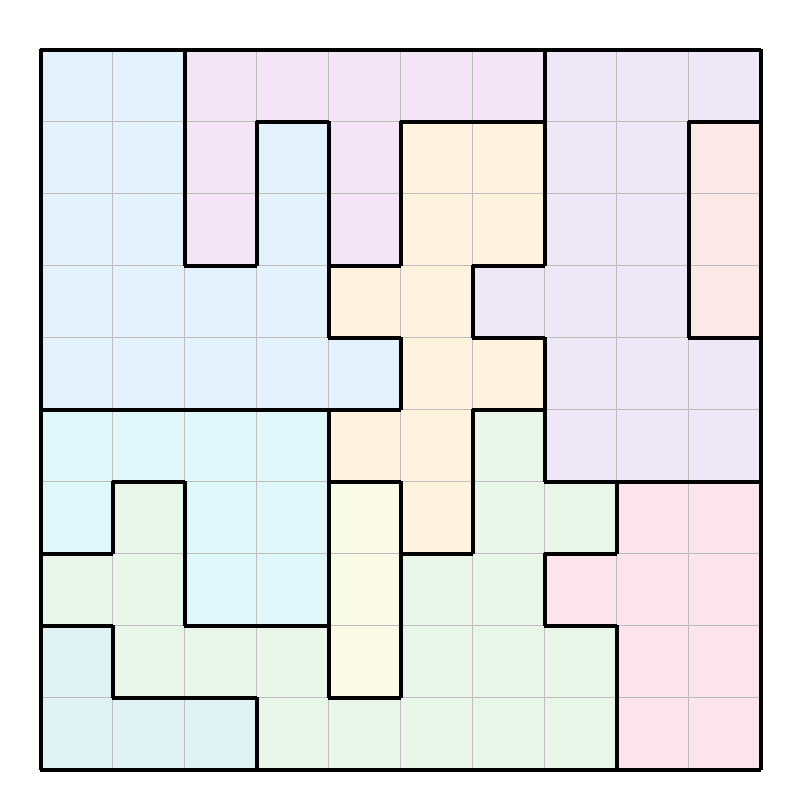
Star Battle is a grid-based logic puzzle about placing stars into a board divided into regions. The goal is simple to understand: place the required number of stars in every row, every column, and every outlined region, while making sure that no two stars touch each other, even diagonally.
The puzzle is also known in some places as Queens, especially in one-star versions where players place one queen or star in each row, column, and colored region. The popular online game Queens on LinkedIn follows this same core idea: one queen in each row, column, and colored region, with no queens touching, even diagonally.
Star Battle is part of the larger family of object-placement logic puzzles. According to The Art of Puzzles, Star Battle was created by Dutch puzzle maker Hans Eendebak for the 2003 World Puzzle Championship in Arnhem, the Netherlands.
Basic Rules of Star Battle
A standard Star Battle puzzle has three main rules:
- Each row must contain the required number of stars.
- Each column must contain the required number of stars.
- Each outlined region must contain the required number of stars.
- Stars may not touch each other horizontally, vertically, or diagonally.
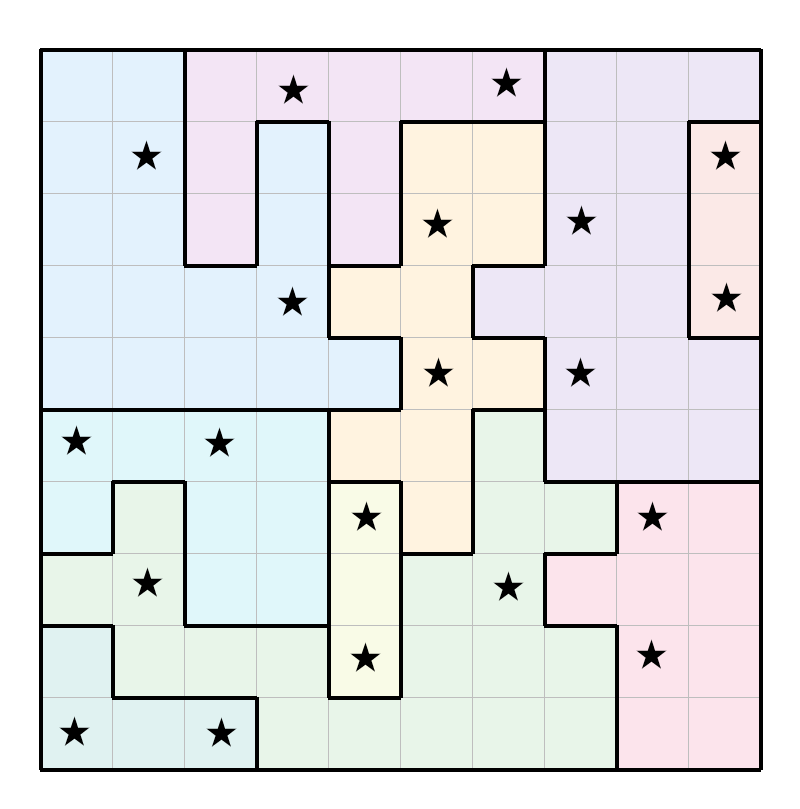
For example, in a common 10×10 two-star puzzle, every row, every column, and every bolded region must contain exactly two stars. Stars cannot touch, not even diagonally. This 10×10 two-star format is widely used in tutorials and online puzzle collections.
In a one-star puzzle, each row, column, and region contains one star. In a two-star puzzle, each contains two stars. In a three-star puzzle, each contains three stars. Puzzle-star-battle.com explains the rule in this scalable way: for 1★ puzzles, place one star in each row, column, and shape; for 2★ puzzles, place two stars in each row, column, and shape; and so on.
What Does a Completed Star Battle Look Like?
A completed Star Battle grid has stars placed so that all constraints are satisfied at once.
For a 10×10, two-star puzzle:
- There are exactly two stars in every row.
- There are exactly two stars in every column.
- There are exactly two stars in every outlined region.
- No two stars are adjacent, including diagonally.
This means the final board is not just a random arrangement of stars. It is a carefully balanced solution where row logic, column logic, region logic, and no-touch logic all work together.
Why Star Battle Is Fun
Star Battle is easy to start but can become surprisingly deep. The rules can be explained in less than a minute, but solving a hard puzzle may require several layers of deduction.
The fun comes from the way one small discovery creates a chain reaction:
- If a star is placed, all eight surrounding cells become impossible.
- If a row already has all its stars, the rest of that row can be eliminated.
- If a region has only a few possible positions left, some stars may become forced.
- If several rows, columns, or regions are “locked” together, large parts of the board can suddenly become clear.
Krazydad’s Star Battle tutorial explains this basic solving rhythm: when a star is placed, surrounding squares can be eliminated, and when a row, column, or bolded region reaches its required number of stars, the remaining cells in that unit can also be eliminated.
This is why Star Battle feels satisfying. The player is not guessing. The best puzzles guide the solver through a sequence of logical steps.
A Simple Solving Example
Suppose a two-star Star Battle puzzle has a three-cell region in a straight line:
□ □ □If that region must contain two stars, the middle cell cannot be a star, because any star in the middle would touch either side. Therefore, the only possible arrangement is:
★ ・ ★That one deduction immediately gives you two stars and one eliminated cell. Then the stars eliminate their neighboring cells, which may help solve nearby rows, columns, or regions.
This kind of “entry point” is very important in good puzzle design. A puzzle should not simply hide a solution; it should give the solver a fair way to begin.
Common Solving Techniques
1. Mark the cells around a star
Once you know a cell is a star, all neighboring cells become impossible. This includes the eight surrounding cells: up, down, left, right, and the four diagonals.
2. Complete a row, column, or region
If a row already has the required number of stars, every other empty cell in that row can be marked as impossible. The same applies to columns and regions.
3. Use small regions as entry points
Small regions are powerful. In a two-star puzzle, a three-cell straight region is especially strong because it forces the two end cells to be stars.
4. Look for locked rows or columns
Sometimes a group of adjacent rows or columns must contain all the stars for a matching set of regions. This can eliminate many cells outside that area.
5. Avoid guessing
A well-designed Star Battle puzzle should be solvable by logic. Some online games and puzzle collections emphasize that each puzzle has one solution and can be solved without guessing. LinkedIn’s Queens game, a one-star version of this puzzle family, states that every grid has one right answer and is solvable without guessing.
Star Battle and Queens
Many people first encounter this puzzle type through Queens, especially on LinkedIn. Queens uses the same basic idea as a one-star Star Battle: place one queen in every row, column, and colored region, with no queens touching each other, even diagonally.
The Art of Puzzles also describes LinkedIn’s Queens as a very accessible one-star version of Star Battle.
For American readers, Queens may be the most familiar doorway into Star Battle. If you enjoy Queens, Star Battle is the natural next step, especially the 10×10 two-star version.
Variants and Advanced Forms
Star Battle has several interesting variants. These variants keep the core idea of placing non-touching objects, but change the board, the regions, or the additional restrictions.
1. Shapeless Star Battle
In Shapeless Star Battle, the usual region structure may be changed or removed. The focus shifts more heavily to row, column, and no-touch logic. Puzzle-star-battle.com offers both regular Star Battle and Shapeless Star Battle as online puzzle types.
2. Antiknight Star Battle
In this variant, stars cannot touch normally, and they also cannot be placed a chess knight’s move away from each other. This adds a wider exclusion pattern and makes the puzzle more restrictive.
3. Toroidal Star Battle
In a toroidal version, the grid wraps around at the edges. The top and bottom edges are treated as connected, and the left and right edges are also treated as connected. This makes edge cells much more important.
4. Small Regions Star Battle
Some variants change the number of stars required in rows, columns, and regions. For example, a puzzle might require two stars per row and column but only one star per small region.
5. Hex Star Battle
Some versions use a hexagonal grid instead of square cells. This changes the meaning of rows, columns, and adjacency.
Advanced Star Battle variants such as Antiknight, Toroidal, and Small Regions are introduced in puzzle competition materials such as UK Puzzle League’s Advanced Star Battle instruction booklet.
Who Plays Star Battle?
Star Battle is popular among several types of puzzle fans:
Casual logic puzzle players
Players who enjoy Sudoku, Nonograms, Minesweeper-like deduction, or Queens often enjoy Star Battle because the rules are visual and easy to learn.
Speed solvers
Online Star Battle sites track solving times and rankings. Puzzle-star-battle.com has public speed rankings and a global leaderboard; one ranking page lists over 127,000 ranked players, which suggests a large international online solving community.
Puzzle competition solvers
Star Battle has roots in the World Puzzle Championship. It was created for the 2003 World Puzzle Championship in the Netherlands, and it remains part of the culture of competitive logic puzzles.
Fans of daily puzzle apps
The rise of daily bite-sized logic games has helped bring Star Battle-like puzzles to a broader audience. LinkedIn’s Queens is a good example of a one-star version reaching general users beyond traditional puzzle communities.
How Popular Is It in the United States?
Star Battle has a strong presence among U.S. logic puzzle fans, especially through online puzzle collections and daily games. Krazydad, a well-known U.S.-based puzzle site, offers Star Battle puzzles in one-star, two-star, and three-star varieties, and also provides tutorials for beginners.
The puzzle has also become more visible to American casual players through Queens on LinkedIn, which uses the same one-star row/column/region/no-touch concept.
It is difficult to give a precise total number of Star Battle players worldwide, because many people solve on different websites, apps, PDFs, puzzle books, and competition platforms. However, public leaderboards, online puzzle archives, and daily game versions show that the puzzle has an active international audience.
Why Star Battle Works Well Online
Star Battle is especially well suited to digital play because:
- It uses a clean grid.
- It has simple input: mark a cell as a star or not-a-star.
- Mistakes can be checked automatically.
- Hints can point to rows, columns, regions, or forced placements.
- The same rule system supports beginner and advanced puzzles.
This makes it ideal for websites, mobile apps, educational tools, and daily puzzle formats.
Tips for Beginners
If you are new to Star Battle, try this order:
- Look for very small regions.
- Mark cells that cannot contain stars.
- When you place a star, immediately eliminate the surrounding eight cells.
- Check whether any row, column, or region is already full.
- Look for rows, columns, or regions with only enough remaining spaces for the required stars.
- Avoid guessing.
For beginners, one-star puzzles or Queens-style puzzles are the easiest entry point. After that, the standard 10×10 two-star format is a natural next challenge.
Recommended Sites and References
Play Star Battle Online
Puzzle-Star-Battle.com
A dedicated online Star Battle site with regular Star Battle, Shapeless Star Battle, daily puzzles, rankings, and multiple star counts.
Learn With Tutorials
Krazydad Star Battle Tutorials
Krazydad offers printable puzzles and tutorials, including 10×10 two-star Star Battle explanations.
Read About Puzzle History and High-Level Puzzle Design
The Art of Puzzles / GMPuzzles
A high-quality puzzle site with Star Battle rules, history, examples, and variants. It explains that Star Battle was created by Hans Eendebak for the 2003 World Puzzle Championship in Arnhem, the Netherlands.
Try a Casual One-Star Version
LinkedIn Queens
A daily visual logic game based on the one-star Star Battle idea: one queen in each row, column, and colored region, with no queens touching.
Final Thoughts
Star Battle is one of the best examples of a modern logic puzzle: simple rules, visual clarity, and deep reasoning. It can be enjoyed casually in a one-star format, or studied seriously in harder two-star and three-star forms.
For beginners, it offers quick “aha!” moments. For experts, it offers rich deduction, elegant region design, and difficult no-guessing logic. That combination is why Star Battle continues to grow among online puzzle fans, competition solvers, and daily game players around the world.